
If you haven’t been living under a rock, you probably have heard about Squid Games, Kimchi, BTS, etc. This is attributed to the “Hallyu wave,” which points to the widespread interest of people worldwide in Korean culture, media, food, and all things Korean. However, Korean cuisine's roots remain one of the lesser-explored parts of this Hallyu wave.
Food and cuisines can always be traced to their history and geography. In this article, we will particularly explore why the Korean palette is the way it is today.
What is Hansik?

Hansik is made up of two words “han” derived from “hangug” meaning Korea and “sik” derived from “eumsik” meaning food. Hansik, traditional Korean food, is a celebration of the earth’s natural foods. Korean diet is deeply tied to nature in the sense that seasonal foods are celebrated and emphasised. The variety of colours and flavours in their food denotes a deeper level of knowledge and appreciation of their surroundings. The five major colours in their diet include - red, green, yellow, black and white representing harmony for the body. These colours also represent the five basic flavours salty, sweet, umami, spicy and sour.
Undoubtedly, Hansik has various health benefits like anti-inflammatory, anti-ageing, anti-bacterial and improved immunity etc.
What does the Hansik consist of? A traditional Korean meal consists of a bap (bowl of rice), soup (either guk or tang) and Kimchi along with an array of banchan dishes with one serving called bapsang.
The banchan culture

If you ever order at a Korean restaurant, you might get confused when you see a variety of dishes come out when you probably just ordered one! Those little dishes holding the excellence of Korea’s fermentation and preservation techniques and knowledge of seasonal produce are called banchan.
An interesting fact is that banchan is always served in odd numbers because of the belief that even numbers are bad. Although we don’t know the basis of this superstition, it is surely exciting to know this piece of cultural nuance!
Banchan, usually placed in the middle of the table, is meant to be shared fostering the value of community. There is a huge array of banchan however some of the most famous banchan are:
- Kimchi: It is a vegetable fermented with salt and chilli powder. This is the staple banchan served everywhere and with almost every dish. There are over 200 varieties of kimchi and it has innumerable health benefits.
- Namul: It refers to steamed, marinated or stir-fried vegetables that are seasoned with red chilli, garlic, soy sauce etc. The most famous namul banchan include sigeumchi namul, samsaek namul, dureup, and kong namul.
- Jorim is a broad name for dishes in which vegetables, meat, tofu, and seafood are boiled and simmered in various spices.
- Bokkeum: The word “bokkeum” refers to anything stir-fried
- Jeotgal: Fermented fish and it can be both dry and liquid.
- Jjim: This banchan refers to meat and seafood dishes that have been either steamed or boiled while being marinated in a sauce or soup.
- Jeon: Refers to Korean-style pancakes.
The role of fermentation

Historically, the Korean diet was centred around fermentation. Fermentation is common in most Asian cultures, such as Japan, China, India, etc. It helps preserve and store food effectively for a longer period and even helps manage overproduction.
When we speak about Korean cuisine, one word that comes to mind is Kimchi. Kimchi is so much part of Korean culture and identity that when Soyeon Yi, Korea’s first astronaut, went into space, she took specially made kimchi.
Kimchi is a vegetable fermented in salt. Although the cabbage kimchi takes centre stage today, historically, kimchi was made with a variety of vegetables like cabbage, sweet potato, eggplant, radish, turnip, lettuce, dropwort and leaf mustard. Besides vegetables, various other ingredients were added to enhance its flavour like red pepper powder, garlic and jeotgal. Kimchi can be eaten fresh but is usually fermented for several days before consumption. Some people prefer eating ripe kimchi called mugeunji which has been fermented for over a year lending a bold flavour and strong pungent aroma.
According to the classical literature, Samguk Sagi (History of the Three Kingdoms), the cabbage kimchi has been consumed for about 2000 years.
You would be surprised to know that Kimchi did not enjoy the same level of popularity in the past and it was considered an inferior food consumed by the poor and despised for its pungent smell. It took various studies to point out the health benefits of Kimchi and large-scale government efforts to uplift the status of Kimchi. Here the mention of Kimjang becomes necessary. It is the large-scale collective preparation of kimchi, during late autumn, allowing them to prepare enough batches of kimchi to sustain through the winters. In 2013, Kimjang was listed as a UNESCO Intangible Cultural Heritage of Humanity.
As of today, Korea is among the top 10 countries with the highest life expectancy, a huge part of which is attributed to its daily consumption of vegetables, including Kimchi.
Apart from the face of Korean cuisine Kimchi, various fermented sauces form the base of many Korean dishes. They are known as “the jang trio,” namely, Doenjang (soybean paste), Gochujang (red chilli paste), and Ganjang (soy sauce). Similar to the French “mother sauces,” you can use them to create numerous other sauces and marinades.
Soybean is the primary ingredient for making jang meaning fermented soybean paste. Soybean farming has been in Korea since the Bronze Age, as the archaeological findings and historical documents suggested. Jang can be both solid and liquid,

Ganjang is a basic soy sauce used as a seasoning in many dishes and has a salty and savoury umami taste while doenjang refers to the fermented soybean paste that is used to prepare the base for soups and stews. Gochujang is a unique seasoning as it is a fermented chilli paste that has notes of sweetness, spiciness and umami and is used for marinades and sauces.
Cheonggukjang is another fermented soybean product that has a distinct fermentation odour and is consumed in the form of stews and soups. It looks very similar to the Japanese Natto and even has a weird smell however, the bacteria that ferments them is different.
Besides these three pillars of Korean cuisine, there are several types of jang namely ssamjang, jeubjang, dambukjang, and makjang.
Jeotgal, a highly salted-fermented fish product, is typically served as a banchan (side dish). Interestingly, jeotgal has a long history and we have evidence of jeotgal being a part of the dietary practices of the Silla Dynasty that existed from 57 BCE to 935 CE. Some literary evidence also points towards the evidence of liquid jeotgal while others talk about the different materials like pork, rabbit, and deer with cooked grains and red pepper powder to prepare jeotgal.
It might surprise you to learn that Vinegar is the oldest fermented food in Korea. It is widely used as a seasoning, an effective home remedy, and a stimulant of appetite.
The rise of Ramyeon

When discussing Korean food, we cannot skip the now international sensation ramyeon. The roots of ramyeon go back to 1963 when it was used as cheap filler food to provide for the starved and famished populations during the post-Korean War period.
Although it has no health benefits, the consumption and popularity of ramyeon is very high. There are many reasons to explain the popularity of ramyeon:
- Koreans prefer to eat ramyeon to overcome and deal with hangovers also known as haejang. The Korean nation is the second-highest consumer of alcohol in the world!
- The flavourful ramyeon soup base is often used as a flavouring agent for other dishes and thus, it’s not surprising that it is a camping essential.
- The pop culture contributed to the popularity of ramyeon with K-pop idols and Kdramas regularly showing the consumption of ramyeon.
- Lastly, ramyeon is also rationed out as emergency food in Korea. Areas hit with natural disasters often receive ramyeon along with other essentials.
Seasonal street foods in Korea

Every season brings its unique flavour to Korea and the lively street food markets provide a unique sensory experience with different smells wafting through the alleys, different tastes and textures being experienced.
Starting with spring
Spring brings sweeter and mellow flavours to enjoy the warmth after a period of harsh winters. Dishes like Hotteok, Jjimpang, Twigim, and Gimbap can be commonly found on food carts. Hotteok is particularly popular during the early spring as it combines the sweetness of red bean paste with the crispy texture from frying feeling like a warm hug. Jjimpang are steamed buns filled with red bean paste and they are served warm.
Summer flavour
The Korean summer is hot and humid and thus, the street food scene switches significantly to offer refreshing and cooling options. Patbingsu, eomuk (fish cake served on skewers in a hot broth) and buchimgae are popular summer street foods. Patbingsu is an essential summer dish in South Korea. It is shaved ice treat topped with red bean paste, ice cream, condensed milk etc. Buchimgae is a type of pancake served with a refreshing dipping sauce made of soy sauce, vinegar, and chilli.
Autumn street foods
Autumn is a popular time for tourists to visit Korea due to its mild and pleasant weather and beautiful foliage. The street foods around Autumn make use of the seasonal ingredients offering a hearty eating experience.
Winter tastes
Korea is well known for its harsh winters with temperatures easily falling below -10 degrees in some places. The street food features various heart-warming dishes like tteokbokki, bungeoppang, and gyeranppang. Tteokbokki is a beloved Korean street food that needs no introduction. It has chewy rice cakes simmered in a thick and spicy gochujang-based sauce. Buneoppang, similar to hotteok, is a warm and sweet bread with a red bean paste filling inside.
Korean drinking culture
The drinking culture in Korea is not about parties or irresponsible teenagers rather it is a system tying social hierarchies, lifestyles and traditions. Similar to other east asian cultures, the practice of drinking dates back thousands of years in Korea and it has its own alcoholic beverages like soju, makgeolli, gukhwaju, baekseju, dansul, bokbunja-ju, maesil-ju. Among these, soju is the most famous alcoholic beverage produced in Korea.
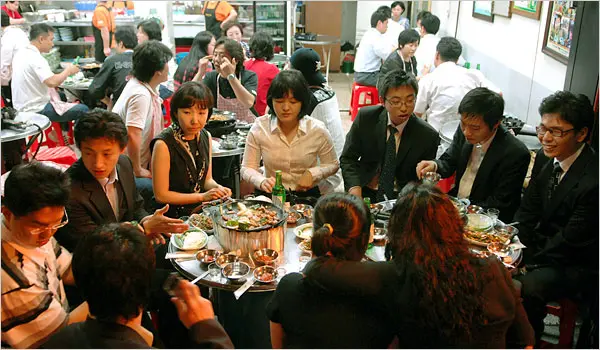
Along with drinks, Koreans like to chew on delicious bar foods called Anju. Interestingly, ancient Korea had little establishments known as jumak which served alcoholic drinks, like Makgeolli and Yakju, and also provided rooms to sleep in. While “Ju” means alcohol, “Mak” stands for curtain or a veil. They also served small dishes of food to go with the drinks which eventually came to be called “Anju”. Although the list is exhaustive, some of the famous anju today are bossam, haemul pajeon, binddaetteok, makguksu, dak galbi, kimchi jiggae, kimchi jeon, buchu jeon etc.
To sum it up, the food and dietary practices of any region or community are shaped by that region’s historical, agricultural, spiritual, ecological and geographical history. You can learn a lot about a country from its food and dietary culture and practices. Korean food history has many aspects and we attempted to cover the major pillars and sections of Korean cuisine.