
In the present context, food has become an important factor in economic development.

introduction
Food is not only for delicious dishes but also for exposing one country's story through its cuisine. In that Food tourism refers to first and second-stage producers of food, food festivals, culinary tourism, and associated restaurants, as well as travel motivated by food. Food tourists can be divided into those who treat food consumption as part of the travel experience, those who use food as a basis for their activities, and those who use food to select the destination itself. (Tae Hee Lee). When we talk about Food in South Korea, it offers a great experience through the country's rich culinary heritage, and it attracts visitors with a diverse range of Flavors, ingredients, and traditions. Renowned for its vibrant street food culture, bustling markets, and Michelin-starred restaurants. South Korea's different local markets displayed its distinctive culinary treasures. Over the past few years, South Korea has become a dominant player in gastro diplomacy. It has effectively used its cuisine to promote cultural exchange and has emerged as a global leader in this field by launching initiatives like the "Korean Wave" (Hallyu) and promoting Hansik (Korean cuisine) abroad, South Korea has successfully positioned itself as a culinary hotspot for those who seek authentic and immersive food experiences. South Korea purposefully placed food tourism as a key role in economic growth, recognizing the massive potential of its culinary heritage to attract international visitors and inspire economic activity. With a concerted effort to promote its diverse gastronomic offerings, South Korea aims to leverage food tourism as a substance for job creation, revenue generation, and regional development. In this paper, I will use Keynesian theory, which was developed by the economist John Maynard Keynes. The theory highlights collective demand's importance in determining economic outcomes. During a depression, the government can intervene with fiscal and monetary policies to stabilize and stimulate activity. Promoting tourism and culinary experiences in South Korea's food sector can boost consumption and investment, increasing aggregate demand. Keynesian economics supports government intervention, so the South Korean government can implement policies to intervene in food tourism. In this paper, we learn about the South Korean food tourism Impact on its economic development and what challenges it faces from foreigners and local Korean people
Background
The Korean Wave, also known as the Hallyu Wave, gained international recognition in 2000. It all started with the film industry and drama series, also known as K-Drama, followed by the music industry with K-Pop. Finally, the food industry also evolved. Korean cuisine's vision is to achieve globalization through its Hansik goal. In May 2009, the Hansik Globalization Development Agency was established. This agency is made up of 36 members from various government departments, academic institutions, and CEOs from the food industry. The government funded Hansik Foundation was founded in March 2010, followed by the enactment of the Foodservice Industry Promotion Act in March 2011. These initiatives were designed to prepare the Hansik Globalisation Project to become a driving force in the food industry. Korea's vision for Hansik (Korean cuisine) globalization is ambitious. The Ministry of Food, Agriculture, Forest, and Fisheries, the Ministry of Foreign Affairs and Trade, the Ministry of Culture and Tourism, the Ministry of Knowledge and Economy, as well as local governments nationwide, have all been involved with strategies for Hansik globalization. Policies are also funded and supported by the First Lady of Korea (Jong-Moon Choi). From this period government of South Korea saw potential in the food industry and to make it famous on an international level or globally food they started different types of policies for the promotion of Korean food
Evolution of Korean food

Korean food is renowned for its unique Flavors and its healthy nature. It has gained popularity worldwide. The role of the government in promoting its food habits through initiatives such as the Korean Food Foundation and the Seoul Food and Hospitality. An increase in food tourism led to a rise in the number of tourists visiting Korea to know the taste of Korean cuisine. The gastro diplomacy program of South Korea's government makes Korean cuisine more available and attractive to international consumers The tipping point was brought about by Psy's "Gangnam Style" and South Korean boy band, BTS, who sell to crowds in many countries despite performing in a different language. (Sang-Hun, 2021) The South Korean government has been promoting food tourism since its early stages. However, the Ministry's financial support for food tourism was low until 2003.

Support increased after 2004 and the budget rose to KRW 2.3 billion in 2009. The government collaborated with the Korean Tourism Organization to publish Michelin Red Guide Korea, cultivate Michelin-starred Korean restaurants, and make Kimchi a UNESCO cultural heritage. The concept of Hansik encompasses all aspects of Korea's agriculture and food industries, aimed at developing Korean agricultural competitiveness in the global market. The Korean government used the slogan "Hansik enjoyed by people around the world" and utilized Hansik globalization as the instrument for strengthening national competitiveness. By 2012 Korean plans reached USD 10 billion in agri food exports and by 2017 Korea attempted to advance Hansik into common world cuisine, as well as one of the world's top five foods. (FOOD AND THE TOURISM EXPERIENCE: THE OECD-KOREA WORKSHOP O OECD 2012) Korea first introduced the franchise system and it has recorded approximately KRW 84 trillion in turnover, which is 7% of GDP, hiring 150 million employees worldwide. The fast-food franchises are Lotteria (the late 1970s), McDonald's (early 1980s), Burger King, KFC, and different Korean Franchising companies such as BBQ, and Nolbu have been great successes in fast food franchises in the country.
Economic benefits from south korean food

Food tourism in South Korea has enriched the cultural experience for travellers and created financial development and job opportunities across various industries. It has led to employment in food production, agriculture, culinary education, local markets, and retail outlets. The restaurant industry has also been boosted, with opportunities for chefs, cooks, and servers. The demand for hospitality professionals, including hotel staff, concierge services, and tour guides, has also increased due to the influx of tourists seeking culinary experiences. The Korean food industry has grown since the 1970s, because of economic growth and expansion of household consumption expenditures. In 2007 the food industry grew at an average annual rate of 5.9%. by 2008, food service industries took in KRW 40 trillion (52%) which is more than half of the KRW 77 trillion domestic franchise market (research by the Ministry of Knowledge and Economy) in 2019 the production of the food industry was KRW 96.5 trillion and USD 128.7 billion, it was 1.9%, The Korean food market was growing global demand for Korean processed foods, exports have been rapidly and continuously growing worth USD 128.7 billion as of 2019, which was 1.9% of the global food market. In response to the recent growth of emerging markets, such as China and ASEAN countries with a high demand for processed foods, in Southeast Asian and Chinese markets and due to the country's geopolitical position the Korean food industry continuously expanding while regularly making the transition from a domestic to a global level During this period, the food industry experienced an increase in high-value-added growth engines due to COVID-19. The establishment of non-face-to-face distribution and home meal replacement facilitated this. Additionally, the expansion of free trade agreements, cooperation with foreign companies, and the development of new products have all contributed to building the foundation for further growth. Active overseas expansion and increased exports have played a significant role in this regard.
In 2020, South Korea's agri-food exports increased in value by 4.9% YoY to reach US$4.85mn.
Kimchi and ramen
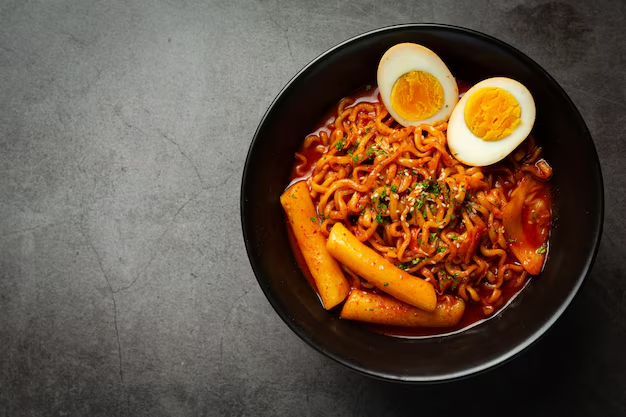
The social media platform helped in the popularity of Korean food because of the trend of ramen and chill oil noodles. It became famous worldwide. The food products that saw the highest increase in global demand were kimchi, the traditional south korean side dish, which was top grower by 40.3% to hit US$97.9mn in export value and another traditional local food - ramen, which grew by 36.7% year on year to US$405.4mn. “Even through the difficult situations faced such as the global economic downturn caused by COVID-19, South Korea has [managed to thrive] by selecting strategic food items to actively promote via non-face to-face or online marketing, which led [to this success]" said MAFRA minister Kim Hyeon-Soo.
Other food products demonstrated impressive export growth. Sauces surged by 23.5%, reaching a value of US$200.9 million. Chicken exports increased by 24.2%, hitting US$50.2 million. Additionally, rice products experienced a robust growth of 21.7%, totaling US$85 million in value.
"Within sauces, gochujang( red pepper paste) exports especially grew significantly due to the rise of the home cooking trend, rising 35.6% to US$32.2mn in value within the first eight months of the year- this was especially due to demand from china, where exports grew 72.5% to reach US$6.5mn" kim said
South Korean Government's Role in Food Development
The role of the government in the development of food tourism was: Every year the government launches different schemes to attract tourism from different countries. There are some events I mention below,
1) These are an event hosted by the Korean government Korea Year 2010 and the Korea Food Tourism Festival held in October 2010 in Jeonju, was an incredible chance to showcase and promote the excellence of great regional Korean cuisine.
2)The musical B-bap Bibimbap is already famous as an international food, and it was reborn through the non verbal performance, B-bap is Nanta and jump. It is the upgraded version of Bebop Korea which the Ministry of Food, Agriculture, Forestry and Fisheries and Fisheries Marketing Corporation produced in 2009.
3) Rural cuisine concerts the 121st regular concert (23-24 March 2011, Sejong Art Centre) of the Seoul City Choir (conductor Oh Sejong) was deemed as the "rural cuisine concert Suunjapbang and Chunhyang Suunjapbang is the first Korean cookbook which was written in 1540 during the Joseon Dynasty. It is a remarkable reference for the cuisine and recipes of the Joseon Dynasty and provides an understanding of Korean ancestral food culture.
Analysis and perspective
Food is an important attraction for travellers, mostly for those people who are traveling abroad. As food tourism grows, food is becoming an important part of the marketing strategy of places of destination. South Korean food tourism has risen rapidly because of Hallyu and the South Korean government has taken the initiative to promote its presence at the global level through soft power. Food tourism helps the country to build relations with another country in the sense of soft power or cultural diplomacy. K-food is considered a healthy food because it is mainly prepared by fermenting vegetables. Food tourism is a great way to promote local businesses, including restaurants, food producers, and chefs. By showcasing their products and services to people, these businesses can benefit from increased sales, brand recognition, and overall business growth. This is especially important for small and medium-sized enterprises operating in the food and hospitality industries. Regional cuisines are a vital component of food tourism, encouraging visitors to explore destinations beyond major cities such as Seoul and Busan. Food tourism benefits rural areas and smaller communities, contributing to the development of regions. Food tourism is an important factor in preserving and promoting South Korea's culinary heritage and cultural traditions. As tourists explore local cuisines, ingredients, and cooking techniques, they develop a greater appreciation for the rich culinary heritage of the country.
Food tourism has a positive impact on economic development in South Korea. However, some implementation issues need to be addressed.

Tourists often face communication problems in local markets as local people cannot communicate in English or other languages, creating a language barrier. According to a survey conducted by the Korea Tourism Organization in 2010, with 300 inbound Chinese tourists, their biggest complaint was the "lack of signs and information in the Chinese language" (53.7%). To address this issue, the government should provide facilities to local vendors to help them communicate with tourists.
2)The South Korean local markets are famous and popular tourist destinations for visitors who want to explore the culture and food habits of local people. However, due to the increase in food tourism, local vendors have increased the price of food to earn extra money from visitors, which has caused problems for local people. The government should take some steps to solve the problem of local people to maintain the price of the food.
3) Local people often leave their villages in search of better education or job opportunities. This has resulted in many villages becoming empty and abandoned. To address this issue, the government can consider redeveloping these villages or transforming them into tourist destinations to attract visitors. This way, the elderly people residing in these villages can have a source of earning and the villages can thrive again.
4) In recent years food tourism has increased in South Korea and Vegetarian(vegan) food consuming people face a lot of problems. Private companies should launch more products for vegetarian people.
Conclusion
Food tourism has been an integral part of cultural diplomacy and has played a vital role in economic development. In the case of South Korea, food tourism has been a significant contributor to its economic growth since 2008, when the South Korean government started promoting its soft power. This promotion has been part of the Hallyu wave, and Korean food has become well-known globally due to the popularity of Korean dramas and K-pop. The actors and singers often showcase Korean food in their shows, which has
helped to make South Korea a popular tourist destination for people from all over the world. The South Korean government sees food tourism as an important factor in boosting its economy and soft power promotion with other countries. The food tourism industry generates jobs and opportunities in various sectors. South Korea has become a leading exporter thanks to its food tourism and Hallyu wave. Overall food tourism field in South Korea has a positive impact on economic development and building a positive image on an international level.
Reference
Hansik Comprehensive Information Service: www.hansik.org. Jeonju International
Fermented Food Expo: www.koreafoodfestival.or.kr Jong-Moon Choi: Globalising Korean
food and stimulating inbound tourism OECD (2012), Food and the Tourism Experience: The OECD-Korea Workshop, OECD Studies on Tourism, OECD Publishing.
http://dx.doi.org/10.1787/9789264171923 https://www.investkorea.org/ik-en/cntnts/i-317/web.do
https://www.investkorea.org/ik-en/cntnts/i-317/web.do